

Reviewed · JAIPUR CITY SIGHTSEEING TOURS
Explore Jaipur Like Never Before
Jaipur is more than forts and royal photo stops. This three-hour walk with Shristi looks at how the city works, from the women’s windows of Hawa Mahal to the market lanes where silver, stone, and printed cloth shape daily life. I like the small group limit of seven, which should make questions and conversation easier. I also like the focus on stories and local logic instead of a quick checklist of monuments.
The main thing to consider is that this is a walking experience, not a grand palace tour with long interior visits. You spend time on streets, in bazaars, and at historic meeting points. That is its strength, but it may not suit you if you want a formal tour of Jaipur’s major palace rooms.
Key points at a glance
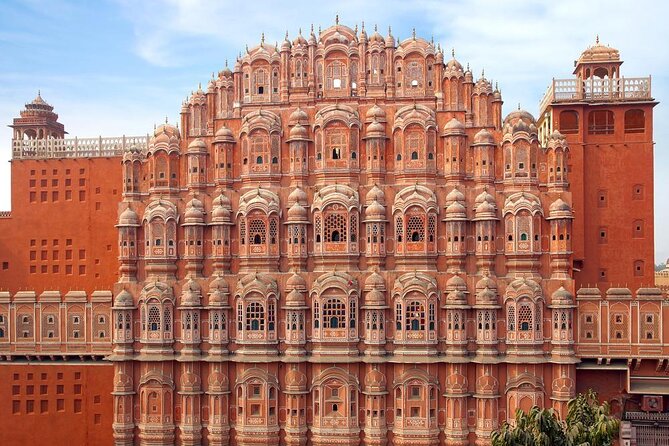
- A different look at Hawa Mahal: Hear how the famous royal windows connect to the lives and movement of Indian women.
- Jaipur’s true color: Learn why the city is better described as terracotta pink rather than a bright, candy-colored pink.
- Market lanes over souvenir counters: Walk through Tripolia Bazar and hear about silver work, stone cutting, and block printing.
- Stories at Jalebi Chowk: Connect royal life, soldiers, and spirituality at a historic Jaipur landmark.
- A compact walking format: Four stops fit into about three hours, with no admission fees listed for the activity.
- Personal guiding by Shristi: The tour is designed around explanation, storytelling, and discussion, with a maximum of seven people.
Why this Jaipur walk feels different
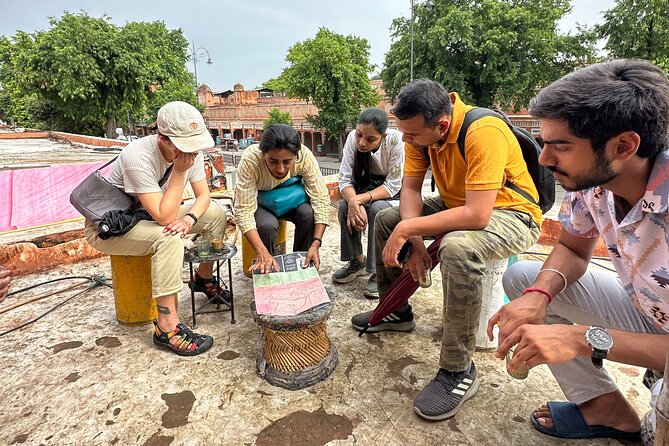
Many Jaipur outings follow a familiar pattern: fort, palace, photo, bus, next stop. This walk takes another route. It uses famous places as doorways into questions about design, social life, trade, religion, and the way Jaipur’s people use the city today.
That approach matters because Jaipur can seem easy to read at first. You see pink facades, broad streets, ornate gates, and royal names. Then you notice the smaller details: the way a market lane is arranged, the work taking place behind a shopfront, or the reason a building includes a particular opening.
Shristi’s tour is built around those details. The description promises history, science, logic, art, and the thought behind the city. That gives you a better reason to walk slowly. You are not only looking for a photograph. You are listening for the idea behind what you see.
The published score is 5 out of 5, with a 100 percent recommendation rate from 15 ratings. The strongest praise focuses on Shristi’s energy, knowledge, and storytelling. One rating specifically highlights how she brought the sights and past events to life. That is important here because this experience depends heavily on the guide’s ability to connect ordinary street scenes with larger ideas.
More Jaipur sightseeing tours:
- Jaipur: Private Full Day Sightseeing Tour By Car with Guide
★ 4.9 · 1,839 reviews - 3-Hour Morning Bike Tour of Jaipur
★ 5.0 · 1,253 reviews - Jaipur: Private Sightseeing Day Tour with Guide by Car
★ 4.8 · 773 reviews
Meeting Shristi at Tripolia Gate
The walk begins at Tripolia Gate, at Tripolia Bazar near Badi Choupad and the J.D.A. Market in the Pink City. This is a useful starting point because you are already near one of Jaipur’s traditional commercial areas rather than beginning at a hotel or an isolated attraction.
You should plan around a three-hour walking experience. The tour ends back at the meeting point, which makes it easier to continue exploring nearby areas afterward. Since the activity is near public transportation, you can also use it as a starting or ending point in a day of sightseeing.
The group can have no more than seven people. I consider that one of the best practical features. A small group is better suited to a market walk, where a large crowd can block narrow lanes and make conversation difficult. It also gives you a fair chance to ask about things you notice along the way.
Mobile tickets are accepted. Confirmation arrives when you book, and service animals are allowed. Most people can take part, but you should remember that this is a walking tour through streets and market areas, not a seated sightseeing ride.
Hawa Mahal through a woman’s point of view
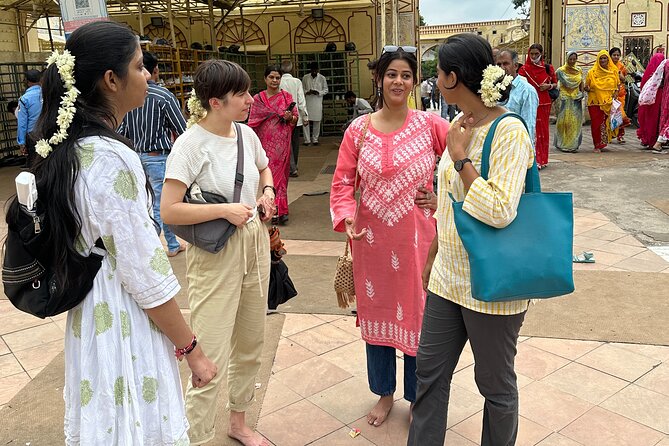
The first stop is Hawa Mahal, the Palace of Wind, for about 30 minutes. You will see one of India’s most familiar buildings, but the tour aims to move past the usual front-facing photograph.
Shristi presents the royal windows from a woman’s point of view. That matters because Hawa Mahal is often reduced to its honeycomb facade. Here, the focus is on what those openings meant for Indian women and how the building relates to movement, visibility, and social expectations.
The experience does not list an admission ticket for this stop. You are there to examine the landmark and discuss its meaning, rather than spend the morning touring every interior chamber. That makes the half-hour slot efficient, especially if you have limited time in Jaipur.
I like this start because it sets the tone for the rest of the walk. You are asked to look at a familiar sight with more care. Instead of treating Hawa Mahal as a decorative backdrop, you consider the people who used it and the society that shaped it.
The possible drawback is simple: if you want a long visit inside the palace, this schedule will feel brief. The value comes from the guide’s explanation and the new angle on the building, not from extended time at the site.
Finding the real pink in the Pink City

The next section lasts about an hour and takes you through the Pink City. One useful correction comes early: the color is actually closer to terracotta pink than the bright pink many people imagine.
That small point opens into a larger discussion about Jaipur’s appearance and identity. The city is not just a collection of old walls painted for visitors. Color, street layout, buildings, and public spaces all help create the feeling people associate with Jaipur.
The walk gives you time to move through the city instead of viewing it through a vehicle window. That pace lets you notice the relationship between old structures and present-day life. The tour’s central promise is to show how Jaipur balances the old with the contemporary, and this is the section where that idea should become clearest.
Shristi uses what the tour calls interesting, logical stories. I like that wording because it suggests an effort to explain why things are the way they are, not just attach dates to buildings. You can expect the conversation to cover the way the city operates, its design, and the ideas that continue to shape daily life.
An hour of walking is also the longest single part of the experience. Wear practical shoes and be ready to keep moving. The tour data does not provide a detailed surface or weather note, so I would not assume an easy indoor stroll. You are exploring streets and public areas in Jaipur.
Same city, a completely different sort of morning:
- Jaipur: Full-Day City Tour with Car, Guide & Skip-the-Line
★ 4.8 · 512 reviews - Full-Day Jaipur Private Sightseeing Tour by Car with Guide
★ 5.0 · 472 reviews - Pink City Cooking Class
★ 5.0 · 452 reviews - Private Elephant Sanctuary
★ 5.0 · 390 reviews
Tripolia Bazar and the work behind the shops

Tripolia Bazar receives about 45 minutes. For me, this is one of the most useful parts of the route because it shifts attention from royal buildings to skilled work and trade.
Jaipur has many side lanes, and the tour points to specialist areas such as silver making, stone cutting, and block printing. You may not enter every craft workshop, since the exact stops within the bazaar are not specified, but the focus is clear: look beyond the main road and notice the work that gives the market its character.
This kind of walk can help you understand Jaipur as a living city. A palace tells you about rulers. A market tells you about production, buying, selling, family trades, and the habits of local life. The two belong together, but the market is often the part people rush through.
I would use this time to ask Shristi direct questions. Ask what a lane is known for, how the trades relate to Jaipur, or which details you might miss without a guide. The small group should make that sort of exchange practical.
There is also a shopping consideration. The tour does not promise a buying session, set discounts, or a particular shop. That is good if you want an authentic look without a sales-heavy program. If you hope to purchase a specific item, do not assume the tour will provide time for careful price comparisons.
Jalebi Chowk and the royal city
The final stop is Jalebi Chowk, with about 45 minutes set aside for stories about soldiers and royal families. The name may sound playful, but the site is presented as a place with serious links to Jaipur’s past.
Here, the tour connects royal living with spirituality. That combination gives the walk a different finish from a standard architecture tour. You are not only hearing about palaces and military life. You are also considering the relationship between power, belief, and the public spaces used by the city.
A good guide can make a place such as Jalebi Chowk easier to understand because its importance may not be obvious from a quick glance. Shristi’s role is to supply the connections: who used the area, what happened there, and how royal and spiritual life met.
The final stop also gives the tour a clear shape. Hawa Mahal introduces social life and women’s experience. The Pink City explains color and urban design. Tripolia Bazar brings in craft and commerce. Jalebi Chowk brings the focus back to soldiers, royalty, and spirituality.
You finish where you started at Tripolia Gate. That is practical, but it also means you can continue in the Pink City without having to arrange a separate return transfer.
What the $39.69 price buys you
At $39.69 per person, this is not the cheapest way to look at Jaipur’s streets. You are paying for a guide-led experience rather than transportation or entrance to a major palace.
The value depends on what you want from your time in Jaipur. If you already know the main monuments and want someone to explain the city’s ideas, stories, and working markets, the price is reasonable for a three-hour private-feeling small-group walk. The maximum of seven people helps protect that value.
If you want admission to Hawa Mahal or another major attraction, this is not the right product to compare. The listed stops do not include an admission charge, and the experience is built around walking and interpretation. You are paying for Shristi’s time, route, explanations, and local perspective.
The strongest value comes when you listen actively. Take note of the details she points out. Ask questions. Watch how the streets change from one stop to the next. A passive walk may feel short for the price, while an engaged walk can give you a better framework for exploring Jaipur on your own.
Who should book this experience
I would recommend this tour to you if you:
- Want more than the standard fort and palace circuit
- Enjoy learning through stories rather than a long list of dates
- Like walking through markets and city streets
- Want to hear a woman’s perspective on Hawa Mahal
- Prefer a group capped at seven people
- Have about three hours for a focused introduction to Jaipur
- Want to connect royal life with ordinary commerce and spiritual spaces
It may be less suitable if you want a vehicle-based tour, extensive palace interiors, or a shopping trip built around specific purchases. The route also asks you to spend most of the experience on foot, so consider your comfort with walking before booking.
The format works especially well early in a Jaipur stay. It can give you a working map of the Pink City and help you understand places you later visit independently. You could also take it near the end of your stay, when you already recognize Jaipur’s major sights and want a more thoughtful final look.
Timing, group size, and cancellation
The experience lasts about three hours, with 30 minutes at Hawa Mahal, one hour in the Pink City, 45 minutes at Tripolia Bazar, and 45 minutes at Jalebi Chowk. These times are approximate, so the actual pace may depend on the group and the streets you explore.
The tour accepts mobile tickets, allows service animals, and is near public transportation. Most people can participate. The group limit is seven, a useful detail for anyone who dislikes large guided groups.
Free cancellation is available if you cancel at least 24 hours before the local start time. Cancellations made less than 24 hours in advance are not refunded, and changes inside that period are not accepted.
My call: book it for the city behind the postcard
Book this walk if you want Jaipur explained through people, work, design, and belief rather than only through royal architecture. Hawa Mahal, Tripolia Bazar, and Jalebi Chowk are familiar names, but Shristi’s route gives each place a wider purpose.
The best reasons to choose it are the small group, the market focus, and the unusual attention to women’s experience at Hawa Mahal. The main limitation is just as clear: you are not signing up for a full palace tour or a ride between monuments.
At $39.69, I think the experience makes sense for an open-minded first look at Jaipur, especially if you value a strong guide and real conversation. Go ready to walk, listen, and ask questions. You will get the most from it if you want to understand why the Pink City feels the way it does, not simply photograph its most famous facade.
FAQ
Where does the tour start?
It starts at Tripolia Gate in Tripolia Bazar, near Badi Choupad and the J.D.A. Market in Jaipur’s Pink City.
Where does the tour end?
The activity ends back at the meeting point.
How long does the experience last?
The tour lasts approximately three hours.
What places are included?
The route includes Hawa Mahal, the Pink City, Tripolia Bazar, and Jalebi Chowk.
How much does the tour cost?
The listed price is $39.69 per person.
Is the tour available with a mobile ticket?
Yes. A mobile ticket is available, and confirmation is received at the time of booking.
How large can the group be?
The activity has a maximum of seven participants.
Are admission tickets included?
The listed stops show admission as free for this activity. The experience does not list separate entrance fees.
Can service animals take part?
Yes. Service animals are allowed.
What is the cancellation policy?
You can cancel for a full refund up to 24 hours before the local start time. Cancellations or changes made less than 24 hours before the start are not accepted for a refund.
Newest Jaipur trips we have written up
- Culture walking and food tour with guide in Jaipur.★ 5.0 · 5 reviews
- Jaipur Private Tour 2 Days with Car & Guide★ 5.0 · 13 reviews
- From Jaipur Private Taj Mahal & Agra Fort Tour with Delhi Drop★ 4.5 · 9 reviews
- Two days Jaipur tour with guide by private car.★ 5.0 · 13 reviews
- Jaipur Full Day Private Tour★ 5.0 · 6 reviews
- Explore Jaipur on a Motorbike – A Unique Experience★ 4.5 · 5 reviews
- Vintage Walk Amer★ 5.0 · 11 reviews
- Walking Tour of Pink City (World Heritage Site) with Local Guide★ 5.0 · 7 reviews
Jaipur City Sightseeing Tours, compared.
Private Full Day Sightseeing Tour By Car with Guide
Read our review →


Full-Day City Tour with Car, Guide & Skip-the-Line
Read our review →
Full-Day Jaipur Private Sightseeing Tour by Car with Guide
Read our review →

Private Full Day Jaipur Sightseeing Tour By Tuk Tuk
Read our review →
Private Jaipur Full One Day Tour In Pink City With Guide
Read our review →Browse the lists this tour appears in